Be yourself; Everyone else is already taken.
— Oscar Wilde.
This is the first post on my new blog. I’m just getting this new blog going, so stay tuned for more. Subscribe below to get notified when I post new updates.
Be yourself; Everyone else is already taken.
— Oscar Wilde.
This is the first post on my new blog. I’m just getting this new blog going, so stay tuned for more. Subscribe below to get notified when I post new updates.
The Black Mirror episode, Nosedive, takes place in a dystopian society where likes and social media act as a form of currency both socially and economically. People try to create the perfect image of themselves in order to obtain a higher quality of life. The lead character, Lacie Pound, desperately does anything she can in order to achieve the lavish and envious lifestyle in which she so desires. In the end, Lacie ends up in prison for going insane and holding a knife up at her friends wedding. In reality, a system to this extreme would never work. People are naturally imperfect, and trying to obtain this socially created idea of “perfection” can drive people to insanity, just as it did to Lacie.
An aspect that this system also affects that is not often spoken about is mentally. Creating this perfect and fake persona can become mentally exhausting, and drive people mentally insane for not being able to express their true selves.
According to the article by John Patrick Hatcher on source Success.com, social media has both positive and negative aspects to it. Social media opens up access to new information, allows people to connect with each other faster and easier, and allow for influence over a widespread audience. The possibilities for how these platforms can be used are endless.
A negative aspect is that social media and advertising companies take advantage of privacy rights. In the microscopic print that no one bothers to read in the place that no one bothers to look, states many social media platforms rights to collect data and own the rights to everything you share on that platform. Even if you delete a post or take down information on media, platforms will still be able to have access to it at any moment and can ultimately use it against you or acquire the rights from it at any time.
Scarily enough, China is adapting a social credit system that resembles the society of a Netflix episode. With social credit systems becoming a reality in our world, social media will also play a part . Through this social credit system, China will be able to have complete control on all aspects of their citizens’ lives.
Black Mirror – Lacie Rates Coworker – Social Credit System (Nosedive S3E1) https://t.co/Eb7p86MMpH via @YouTube
— jsSMH*RME (@JustsmhR) March 29, 2020
Evidence shows that China has plans to gather information from for than just their citizens. The app “Tik Tok” is a social media platform where people can take videos of them dancing, doing comedy or virtually anything they want. This app is especially popular with children and teens. Recent reports have been released that China is using this app to gather information about its users. They are collecting information such as phone numbers and contacts, email addresses, IP addresses and location.
China has developed a facial recognition system that can identify where and what a person is doing at all times. Whether a person is on their way to work, to ride the subway, or any day to day activity, they can be tracked down and recorded.The more information China can gain about people, the more total control they will be able to have. This is digital authoritarianism, and in an age where media encompasses majority of life, it can be considered total authoritarianism.
In America, a system like this would completely violate our constitutional rights to privacy. American citizens having a poor credit score are turned away from housing and are forced to pay more insurance due to a situation out of their control, such as job loss or medical debt.
As Social Credit Systems become a reality in our world, social media will also play a part in these systems. In a strict social credit system, anything posted on social media will be monitored by the government and could ultimately have an effect on your credit score, depending on whether your content is acceptable or not by the government. This limits people’s individuality and their voices. Social Credit Systems are not the ideal system of governance in terms of freedom, and should be avoided at all costs.
Works Cited
Wong, Queenie. “TikTok Accused of Secretly Gathering User Data and Sending It to China.” CNET, CNET, 3 Dec. 2019, http://www.cnet.com/news/tiktok-accused-of-secretly-gathering-user-data-and-sending-it-to-china/.
Hatcher, Jon Patrick. “20 Pros and Cons of Social Media Use.” SUCCESS, 17 Dec. 2019, http://www.success.com/20-pros-and-cons-of-social-media-use/.
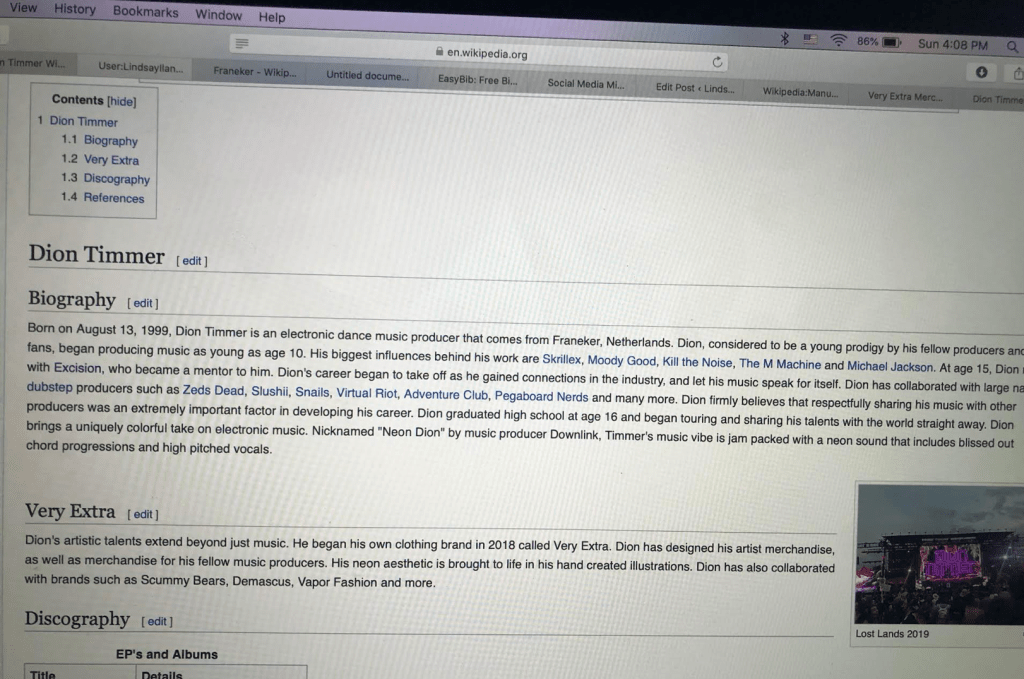
I chose to create my Wikipedia page on my favorite music producer, Dion Timmer. Dion is an electronic dance music producer that comes from Franeker, Netherlands. I have had the privilege of seeing him perform live last September, and have been one of his biggest fans ever since.
Wikipedia is a free online encyclopedia service that anyone in the world can contribute too. By simply creating an account, users can create pages, contribute to articles, and gather an endless amount of information. On Wikipedia, users are able to vote on an admin for the page. After a seven day waiting period, the admin ultimately has control over blocking users who post incorrect or non relevant information. Although anyone has access to edit or change information on Wikipedia, the admin has the control of censorship in the end.
I found creating a Wikipedia page to be much more complicated and elaborate than I though it would. There are so many small steps and details that need to be attended to in order for your page to get published. There are also many different code references that need to be included in order for your entry to follow the proper format.
Wikipedia pages are to be ordered in a list of articles. Headings and sections must be used to separate different text. Sections are best done in paragraph style to avoid a long, run-on pile of information. Notes, links, images, and more are to all be included in your page in order to provide a full and accurate summary of your entry.
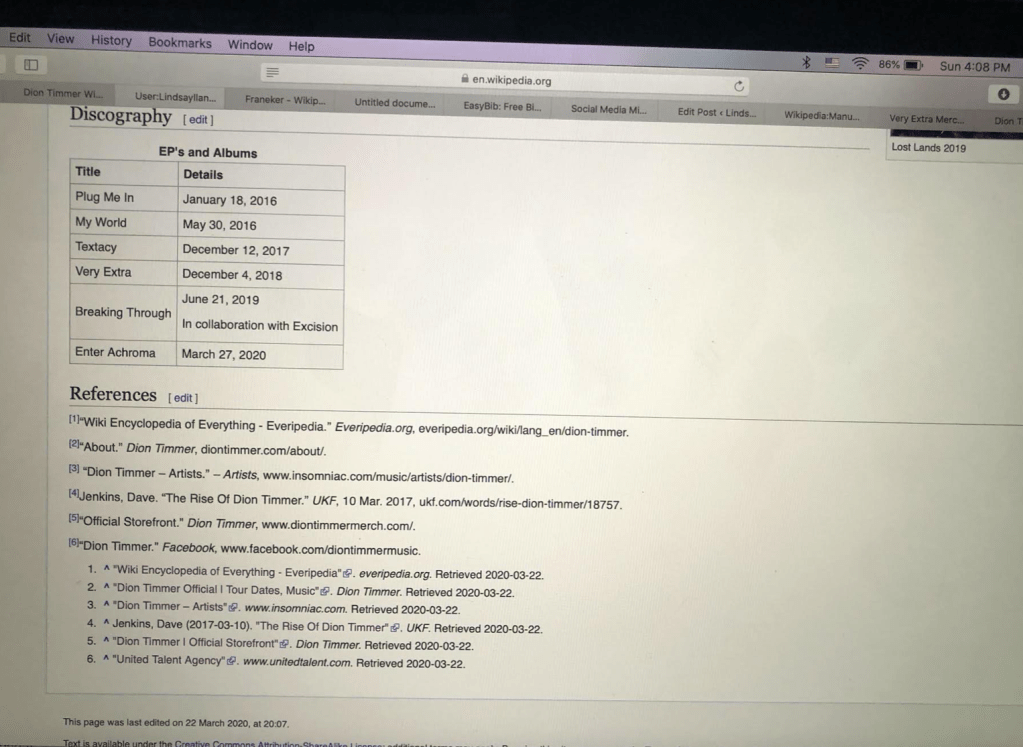
One challenge I ran into while creating Dion’s page was gaining an understanding of the editing tools on the sandbox service. It took me a little while to become familiar with how to format my page the right way. I needed to watch a YouTube tutorial of how to use each button in order to create a professional looking page. Another challenge I ran into while creating my page was citing sources. Since I chose to write my page on a music producer, I had to cite every single song and album that I listed under his discography.
Since I am inexperienced, I chose to use the template sandbox tool while creating my page. This allows you to write your page in the format of how it would show up online. This gave me an easier vision to create my page for exactly how I wanted it to look like. I found the regular sandbox tool to be very confusing for me, as someone who has no experience with entering codes. This mode in sandbox gives more freedom within the format of your page, but can become complicated for a beginner, as you must code in the layout that you choose.
Creating my own Wikipedia page definitely did lead me to question the credibility of the information. Since virtually anyone can add information onto a page, there is no true telling if where they received their information is correct. Sources can often be mistaken as legitimate or writers can lie about where they received their information. It is very important to make sure the sources of a Wiki page are credible and professional sources in order to prevent the pass on of misinformation. Luckily, mistakes can be edited by those who are able to catch them.
Creating my first Wikipedia page was a great learning experience for me. There is a lot that goes into making sure the information is correctly sourced and accurate, which is something I will also take with m e into future assignments and life work when I am referencing a source. Since my page is still under review by Wikipedia, here is a screenshot of it.
Growing up during an era of a technology boom has played a large role in the way people my age behave and interact. There is a long list of myths and misconceptions about my generation as a result of having very different values than those of older generations. The term “millennial” can often times have a negative connotation to older people, or those known as “boomers.” This negative view stems from millennials having a different kind of work ethic and technology obsessed mass. When googling the term millennial, search results can appear such as “millennials are lazy” and “millennials are destroying the world.” My goal within this post is to break these negative myths about my generation and the advances that we grew up with.
The recent and popular meme “Ok Boomer” is a phrase used by younger people in a sarcastic connotation as a way to dismiss the closed minded ideas of boomers. Quoted by Taylor Lorenz from the New York Times, the phrase “has become the younger generations endlessly repeated retort of older people who just do not get it, a rallying cry for millions of fed up kids.” In reality, millennials and boomers have a very different way of viewing and approaching life, and the conflict between these generations originates from both age categories misunderstanding each other’s generational lifestyles. Every generation brings something different to the table in order to create this complex and diverse world in which we reside.
Why is it that the double-space after a sentence is being phased out of modern typing? Even #MicrosoftWord is now flagging the double-space as unnecessary.
— Jason – C1900101 (@NorthFaceHiker) February 11, 2020
Yes, I learned to type on an actual typewriter, but I still don't understand why it's changing.#OkBoomer #DoubleSpace pic.twitter.com/zErYbSpYo2
Social media is more than just a platform to brag or show off, it is a way to communicate with each other, develop a personal brand and even find new opportunities. Especially in recent years, social media has become extremely diverse in how it can be used. I use social media extremely frequently because they are all encompassing platforms. Within a span of only five minutes, I can check up on my peers, receive important news updates, shop and find great deals, make professional connections, laugh at funny posts or memes and the list goes on. Social media today has no limits, and that is a concept that most boomers do not understand. Since they did not grow up in the era of technology, they are not educated on the endless possibilities that being on social media can bring.
Millennials works smarter rather than harder, and this can often times be mistaken as laziness. Just because we take advantage of the technological advancements does not mean we are not putting in any less effort in achieving success.
I am sure that I am not the only one who has received the “When I was your age” speech when I said that I was too tired or did not have enough money to do something to a boomer. In this day and age, it is very common for college graduates to move back home with their parents before fleeing the nest and becoming completely financially responsible for oneself. According to Forbes, the price of college within the last 10 years has increased almost 8 times faster than wages. Although there are student loan services available, these services are only offered to those at a certain level of income. Those in the middle class who can just afford to go to college often times are rejected by these services because they are considered to be stable enough to pay. As my family was on the cusp of receiving financial aid and getting rejected, it is difficult for me to see my parents struggling to pay for my school and support the rest of my family. Attending college has also become much more of a necessity in getting a well payed job than t did years ago. Life in general has become more competitive than it did during the boomer generation. The idea of us being lazy, poor, or motivated . We are working hard, but it has become more challenging to become financially stable in this era, which is something that some older people cannot grasp.
After reading the Jenkins quote, I am aware that the phrase “Generation Me” can be commonly associated with millennials and their excessive use of social media. Social media platforms have played a major part in the way my generation interacts and views each other. Everyone who creates a post on social media Realistically, any generation that would grow up with social media would use it in an egotistical manner. It is only natural for people to want to be viewed by others in a positive way. Social media can provide a community for younger generations to express themselves in the way that they know and have grown up with, without being brought down by the ways of boomers. Both boomers and millennials have undergone different kinds of experiences and struggles, and that is why it is so challenging for these generations to see eye to eye.
Works Cited:
Lorenz, Taylor. “’OK Boomer’ Marks the End of Friendly Generational Relations.” The New York Times, The New York Times, 29 Oct. 2019, http://www.nytimes.com/2019/10/29/style/ok-boomer.html.
Maldonado, Camilo. “Price Of College Increasing Almost 8 Times Faster Than Wages.” Forbes, Forbes Magazine, 25 July 2018, http://www.forbes.com/sites/camilomaldonado/2018/07/24/price-of-college-increasing-almost-8-times-faster-than-wages/.
Norton, Richie. “The 14 Most Destructive Millennial Myths Debunked by Data.” Medium, Mission.org, 20 Jan. 2017, medium.com/the-mission/the-14-most-destructive-millennial-myths-debunked-by-data-aa00838eecd6.
By Lindsay Feller
Within the last decade, the internet has been used by over half the worlds population. It is a way for people to connect and stay up to date with all that they need to know. With all of the great things that the internet can provide, service companies often times take advantage of the masses. Net neutrality is “the principle that individuals should be free to access all content and applications equally, regardless of the source, without Internet Service Providers discriminating against specific online services or websites.” (Public Knowledge, 2017.) No user should feel like they are being withheld online material due to any circumstance, whether it be freedom of expression, privacy rights, or internet access rights (Tim Berners Lee, 2018.)
Over the last decade, there has been many disputes and adjustments to the rules on Net Neutrality. In 2010, the Open Internet rules were put in place to uphold Net Neutrality. Unfortunately, there were many loopholes found in these rules. In 2015, the FCC was able to come up with rules that would make the internet a fair space for everyone. Since a Republican government took charge in the US in 2017, Net Neutrality rules have gone back up into the air. Presidential candidate, Bernie Sanders, strongly believes that Net Neutrality should be enforced on all media companies. His plans and campaign are in support of the working class and making sure that they are being treated fairly.
https://twitter.com/SenSanders/status/994260620877983744
While there are so many people active on the internet, there is also an abundance of people who want to use the internet, but they cannot because of Net Neutrality. According to an article written by Solana Laren, 80 percent of Africa is still offline. The majority of the population there cannot afford it. This only hinders Africa from making progression as a continent.
There would be many consequences and effects if Net Neutrality is not in place. One consequence is that many people who could not afford a computer security system would be a higher risk of online theft, or having any personal information stolen from them. Nowadays, many important money and capital transactions and interactions take place online. At the click of a button, any experienced hacker can steal information that is not properly protected.
In today’s day and age, having access to the internet is a very crucial aspect in success. The internet is flooded with information, opportunities, answers and virtually anything one can think of. Taking away the internet is ultimately just stripping the working class of potential success. In the long run, this would have a negative effect on society by widening the gap between the wealthy and the poor even more.
Another consequence of not having Net Neutrality would be a limited speech. Many people would not be able to share their ideas and views over the internet. This would be a problem since the internet is the quickest way to reach the largest audience possible. Net Neutrality has provided a voice for so many minority groups who have not had one in the past. Without out it, their would be very little social progression and racial justice.
Growing up in the era of the internet, my go to way for finding information has been the internet. It has helped me succeed in my classes and get me to this very point right now. If I were to find myself throughout this time with my internet access restricted because of who I am or because of my status, I would not have been able to get even half way to the level of success that I am at now. I believe that taking away Net Neutrality is the upper class and big businesses way of gaining more power and influence on the world. Since these people already have control over the internet service companies, they use the internet to further their money and power hungry agenda.
The fight for digital rights remains strong alongside other American battles for equality. Our society needs Net Neutrality to grow and flourish as a whole. It is morally wrong to withhold information from someone because of their background. I plan to become active in the fight for online rights and try to make sure all people have access to any online material that they need.
Works Cited
Peri Jonathan, How Killing Net Neutrality will Hurt Online Protests (Masahble, 2017.)
Finley Klint, The WIRED Guide to Net Neutrality (Wired, 2018.)
Larsen Solana, Who Saved the Web (Future of the Internet, 2016.)
This is an example post, originally published as part of Blogging University. Enroll in one of our ten programs, and start your blog right.
You’re going to publish a post today. Don’t worry about how your blog looks. Don’t worry if you haven’t given it a name yet, or you’re feeling overwhelmed. Just click the “New Post” button, and tell us why you’re here.
Why do this?
The post can be short or long, a personal intro to your life or a bloggy mission statement, a manifesto for the future or a simple outline of your the types of things you hope to publish.
To help you get started, here are a few questions:
You’re not locked into any of this; one of the wonderful things about blogs is how they constantly evolve as we learn, grow, and interact with one another — but it’s good to know where and why you started, and articulating your goals may just give you a few other post ideas.
Can’t think how to get started? Just write the first thing that pops into your head. Anne Lamott, author of a book on writing we love, says that you need to give yourself permission to write a “crappy first draft”. Anne makes a great point — just start writing, and worry about editing it later.
When you’re ready to publish, give your post three to five tags that describe your blog’s focus — writing, photography, fiction, parenting, food, cars, movies, sports, whatever. These tags will help others who care about your topics find you in the Reader. Make sure one of the tags is “zerotohero,” so other new bloggers can find you, too.

 Lindsay Feller